Pag is famous for its cheese, its lamb and its salt — but the island also has a wine story that is quietly one of the most interesting in Croatia. It centres on a single stubborn white grape called Gegić, a variety that grows almost nowhere else on earth and that came very close to disappearing altogether. If you are staying in Novalja and want a taste of the island that has nothing to do with Zrce, a glass of Pag white is a good place to start.
Gegić: the grape that almost vanished
Gegić is indigenous to Pag and its immediate surroundings, and for centuries it was the island’s leading variety. It is not an easy grape to farm — it ripens late and yields irregularly from year to year — which is exactly why most growers abandoned it as vineyards across the island shrank through the twentieth century.
What saved it was a deliberate rescue effort. Cuttings were taken from surviving old vineyards in the south of the island and replanted, with the Boškinac estate near Novalja taking the lead in bringing the variety back into serious production. Today only a handful of producers work with Gegić, which makes every bottle something of a local rarity.
In the glass it is dry, lean and faintly bitter on the finish — think citrus peel, green herbs and a slightly oily texture, with enough backbone to stand up to strongly flavoured food. Pag’s hot summers push the ripeness further than you might expect from such a lean style, and bottles commonly land somewhere between 13 and 14.5% alcohol.
Žutica — the island’s old name for its wine
Long before anyone printed a grape variety on a label, the white wine of Pag was simply known as žutica — “the yellow one” — after its deep golden colour. It was usually a field blend, with Gegić at its heart.
Wine has been part of island life here for a very long time. Medieval notarial records from Zadar show vineyards on Pag being bought, sold and inherited by nobles and commoners alike, listed alongside the saltpans as property worth arguing over. By the nineteenth century, imperial visitors passing through were noting the quality of the local wine in their travel diaries. It is a reminder that Pag was a working agricultural island for centuries before it was a summer destination.
Why the karst matters
Anyone who has driven across Pag knows the landscape: bare white stone, low scrub, almost no trees on the seaward side. That harshness is the whole point. Vines here grow in thin pockets of soil between limestone, exposed to relentless sun and to the bura wind that carries sea salt inland from the Velebit Channel all winter.
It is the same combination of salt, stone and wild herbs — sage, immortelle, thyme — that gives Pag cheese and Pag lamb their reputation. The vines are working with the same raw material, and it shows up as a savoury, mineral edge in the wine rather than the soft fruitiness of a warmer, gentler climate.
What to drink it with
The classic pairing is the obvious one, and it works: a glass of Gegić with a plate of well-aged paški sir. The wine’s citrus bite cuts through the richness of the cheese, and the salty, herbal notes on both sides of the pairing echo each other.

Beyond cheese, Gegić is a natural match for grilled Adriatic fish, octopus salad, shellfish and anything dressed with local olive oil. It also holds its own against Pag lamb, which is unusual for a white wine — the savoury character carries it further than most. If you are ordering red instead, the island’s producers work mainly with Cabernet Sauvignon and Merlot, which suit slow-roasted lamb and richer winter dishes.
Where to taste it near Novalja
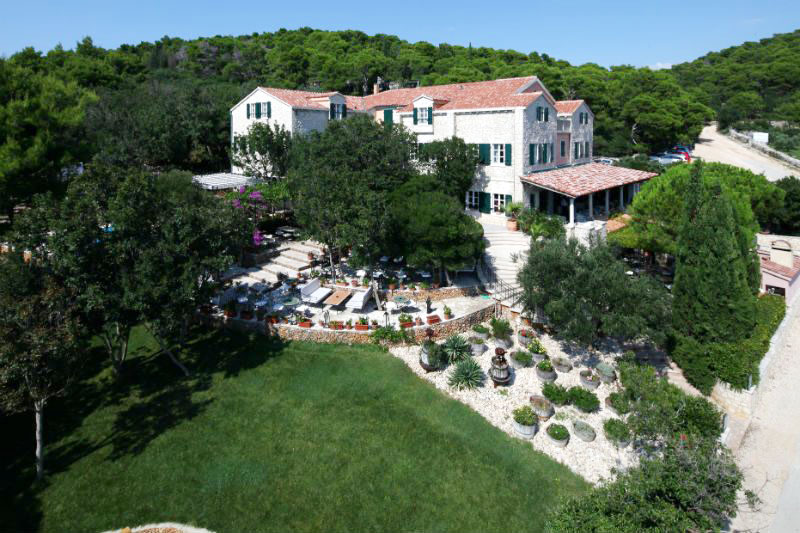
Boškinac is the obvious starting point. The estate sits on a rise in the pine woods between Novalja and Stara Novalja, just a few minutes’ drive from town, and combines a winery, a boutique hotel, a tavern and a fine-dining restaurant that currently holds a Michelin star. Tastings are organised for both hotel guests and visitors, usually paired with Pag cheese and other island specialities, and they come with the story of the cellar attached. Booking ahead is sensible in high season.

Further south, Vina otoka Paga runs a tasting room on the road between Povljana and Pag town, where Gegić is poured alongside island salt and cheese. It is a longer drive from Novalja, but it pairs well with a day trip to Pag town. Smaller family producers also sell directly from their farms inland, mostly around Kolan, Vlašići and Dinjiška — these are informal, often unsigned, and worth asking a local about.
A few practical notes
- Production is genuinely small, so don’t expect to find Pag wine in every supermarket — buy at the cellar or at a specialist shop in Novalja or Pag town.
- Serve Gegić chilled but not ice-cold; over-chilling flattens the herbal character that makes it interesting.
- If you are driving between tastings, remember Croatia’s blood alcohol limit is strict. Plan a designated driver or a taxi.
- A bottle of Gegić plus a vacuum-packed wedge of paški sir is about the best souvenir the island offers — both travel well.
Pag’s wine will never be produced in large volumes, and that is part of its charm. Drinking a glass of Gegić on the island is one of those small, specific pleasures you can’t easily reproduce anywhere else — a simple experience of joy, and a good reason to spend an afternoon away from the beach.